
The global economy is experiencing its largest productivity boost since the internet revolution. Artificial Intelligence is generating a $1.81 trillion addressable market by 2030 from $391 billion today, fundamentally altering how organizations create value and how individuals capture that value through compensation. India is uniquely positioned at the center of this transformation.
While 72% of global organizations have adopted AI in at least one business function, India leads across multiple dimensions. 30% of Indian companies have maximized AI’s value potential versus 26% globally, among tech-based roles, an exceptional 92% of professionals in India regularly use AI tools the highest globally. 73% of Indian businesses plan expanded AI implementation by 2025 compared to 52% globally.
The result is a concentrated wealth effect targeting India’s working age demographic: professionals earning AI-era premiums earlier in their careers, with higher disposable incomes and consumption preferences shaped entirely in the digital age. This cohort demonstrates high willingness to pay for convenience, preference for premium experiences, and comfort with digital-first brands across categories.
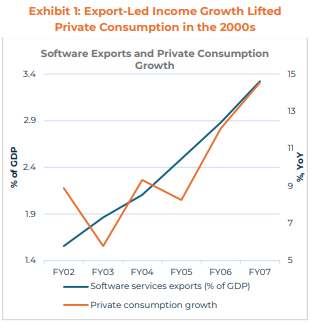
In the 2000s, India’s IT boom reshaped the economy. As software exports rose from about 1% to over 4% of GDP, they powered income growth, urban jobs, and a surge in household spending. The tech wave didn’t just bring dollars it created a new middle class and a culture of aspiration.
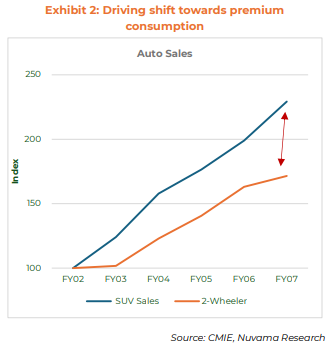
Between FY02 and FY07, passenger vehicle sales in India expanded much faster than two-wheelers, reflecting a structural shift in mobility preferences. Within passenger vehicles, SUVs recorded the sharpest growth, emerging as the key driver of premiumization. This period marked a clear move from basic transportation to aspiration-driven ownership, as rising incomes, affordable financing, and a growing middle class encouraged consumers to upgrade from two-wheelers and small cars to larger, more comfortable SUVs that symbolized lifestyle and status.
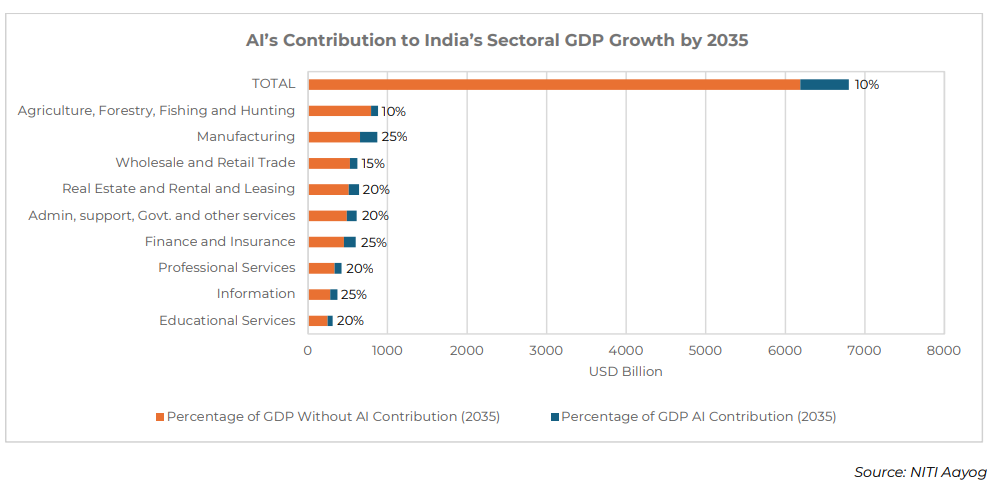
By 2035, artificial intelligence could become one of India’s strongest growth engines, adding $450–500 billion to DP nearly 10 percent of the economy’s size. According to the AI for Viksit Bharat report, the biggest uplift will come from manufacturing, where smart factories, predictive maintenance, and robotics can transform productivity. Financial services will see AI-driven credit scoring, fraud detection, and personalized products deepen inclusion. IT and professional services will evolve into innovation hubs through automation and new digital offerings, while healthcare, education, and agriculture will benefit from better access, efficiency, and resource use. Together, these shifts signal that AI is not just another wave of automation it’s the next great productivity revolution, reshaping India’s growth story much as the IT boom did two decades ago. This staggering growth projection is backed by foundational investments that guarantee high-income job creation:
Global Infrastructure and Investment: The $15 billion Google AI hub and India’s ₹107 billion public investment in AI data centers are anchoring global-scale operations and high-tech jobs within India, laying the groundwork for durable domestic wealth creation.
India’s AI revolution is reshaping its economic hierarchy much like the IT export boom of the early 2000s but on a far larger scale. As per EY–Microsoft (2024) and Accenture (2023), AI could contribute up to 10–15 % of GDP by 2035, unlocking nearly US $900 billion in value. The traditional IT services sector in India is a significant contributor to the country’s economy, accounting for about 7.5% of India’s GDP as of the financial year 2023. This sector is poised for strong growth, with its revenue projected to double to approximately Rs. 43.1 lakh crore (about US$ 500 billion) by 2030. The IT ecosystem is expanding rapidly, driven by demands from various verticals like BFSI, telecom, and retail, and the emergence of new technologies such as AI and engineering R&D.
Indian workers are already saving 1.3 hours daily with AI and seeing 33% productivity boosts. By 2030, 38 million jobs will transform not disappear as AI handles routine work while humans focus on strategic tasks.
This shift is enabling lean startups. What once required large teams can now be done by small groups using tools like GPT-4 and GitHub Copilot. India’s 520+ tech incubators and AI startups are growing 25–35% annually, allowing even non-technical founders to build sophisticated products.
In the US, AI companies have driven unprecedented market cap growth. Nvidia alone hit $5 trillion in market cap and now represents 8% of the entire S&P 500. The “Magnificent Seven” tech giants have seen massive valuations driven by AI infrastructure and applications. Across the US, China, Japan, and South Korea, AI companies have contributed 14–58% of total market cap growth over the past three year.
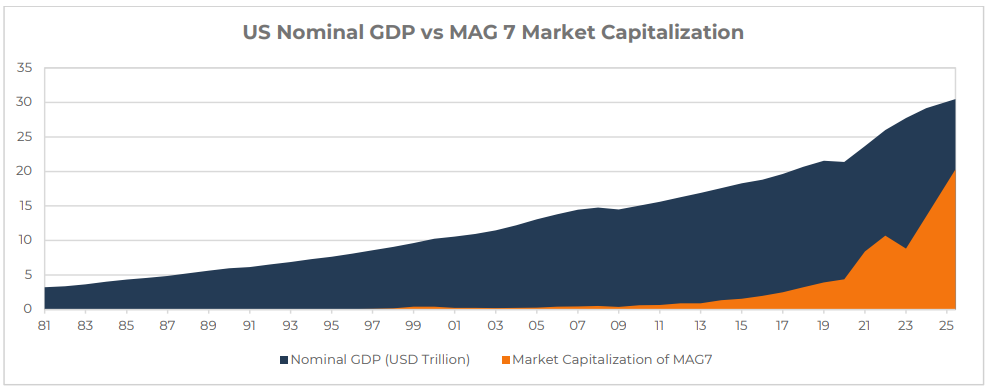
India is yet to follow suit. While the country now has 73 unicorns including AI-focused companies like Ai.tech (conversational AI), Yellow.ai (AI chatbots for Fortune 500), and Uniphore ($2.5B valuation in speech analytics) these remain private. India’s large IT firms like TCS, Infosys, and Wipro are embedding AI into operations but haven’t yet seen the valuation surge of their US counterparts.
India’s IPO market is projected to raise $18 billion in 2025 third globally. The pipeline is increasingly tech and AI-heavy, with AI companies spanning conversational AI, speech analytics, healthcare diagnostics, fintech solutions, and agriculture.
The government’s ₹10,300 crore IndiaAI Mission is accelerating this by funding infrastructure. As more AI companies achieve scale and go public, their contribution to market capitalization will match developed markets, attracting global investors and funding the next generation of AI innovation. As India’s AI unicorns go public and established tech firms demonstrate AI-driven value, India’s markets will experience similar AI-fuelled market cap growth that transformed US exchanges.
As AI boosts disposable incomes, more money will flow into India’s capital markets. Equity penetration in India remains very low compared to developed markets most household savings still sit in fixed deposits and gold. As wealth increases from AI-driven productivity, more individuals will shift savings into equities and mutual funds. This growing investor base will deepen market liquidity, drive demand for sophisticated investment products, and attract international capital creating a self-reinforcing cycle of market development and wealth creation.
Artificial intelligence is transforming urban consumption in India, enabling unprecedented convenience and personalization across key lifestyle sectors as rising disposable incomes fuel luxury spending.
Food & Grocery: Premium food delivery is booming through AI-powered personalization, dynamic pricing, and optimized logistics. Platforms like Swiggy Gourmet and Zomato Gold offer exclusive fine-dining partnerships, with the food delivery AI market projected to grow at 18.52% CAGR through 2028.
Home & Lifestyle: Urban Company taps growing demand for outsourced household services. AI-enabled smart home devices from automated lighting to security systems are rapidly gaining adoption among metro households through cloud-based integration.
Travel & Aviation: Digital travel searches are growing 8-12% annually. Airlines like IndiGo and Vistara use AI for dynamic pricing and personalized loyalty programs. Premium outbound travel surged 32% with average spends exceeding $8,500 per trip in 2025.
Hotels & Leisure: Premium hotels maintain 70-74% occupancy with room rates of Rs. 7,800-8,500. Taj and Oberoi deploy AI chatbots, predictive analytics, and contactless services to enhance guest experiences.
Real Estate: Luxury real estate sales jumped 85% year-on-year in H1 2025, with ~7,000 units sold across major cities. Developers integrate AI virtual assistants and smart home features, while premium auto brands use AI for virtual showrooms and predictive maintenance.
AI-generated wealth pushes India’s middle class from security to self-expression, expanding the top tiers of consumption.
India’s AI revolution is transitioning from early adoption to mainstream wealth creation. The IT boom demonstrated how high-value exports reshape consumption AI will amplify this effect. With projections of $450-500 billion in GDP contribution by 2035, a new high-income cohort is emerging in metros and tier-1 cities. This wealth will disproportionately flow into premium real estate, luxury travel, digital convenience services, and aspirational categories that define modern affluence. The investment thesis is clear: companies positioned to capture AI-driven discretionary spending will outperform as India’s consumption pyramid shifts upward.
Regards,
Team Sowilo
Sources:
NITI Aayog —AI for Viksit Bharat: The Next Productivity Revolution
Microsoft — 2024 Work Trend Index: AI at Work Is Here. Now Comes the Hard Part
EY–Microsoft (India AI opportunity study
Accenture — AI macro-impact research
CMIE & Nuvama Research.
Stanford — AI Index Annual Report
McKinsey; BCG; PwC
Economic Times; NDTV — recent India market datapoints.
DISCLAIMER: Any information contained in this material represents Sowilo’s views and research analysis and shall not be deemed to
constitute an advice, an offer to sell purchase or as an invitation or solicitation to do for security of any entity and further Sowilo Investment
Managers LLP and its employees/directors shall not be liable for any loss, damage, liability whatsoever for any direct or indirect loss arising
from the use of this information. Sowilo Investment Managers LLP – SEBI Registered Portfolio Manager (INPO00008127)

Sowilo Investment Managers LLP (“Sowilo”) is a boutique asset and wealth management corporation catering primarily to HNI and UHNI investors both in domestic as well as offshore markets. Sowilo is a SEBI registered PMS, focusing on discretionary portfolio management.
SEBI Registration No. INP000008127
Mail To: Investor Grievance ID
SEBI SCORES
For Online Dispute Resolution Platform
Smart ODR SCORES
Mobile Application downloaded link


© 2023 All Rights Reserved By Sowilo
Designed & Developed By Dreamz
Sowilo Investment Managers LLP
We firmly believe that the internet should be available and accessible to anyone, and are committed to providing a website that is accessible to the widest possible audience, regardless of circumstance and ability.
To fulfill this, we aim to adhere as strictly as possible to the World Wide Web Consortium’s (W3C) Web Content Accessibility Guidelines 2.1 (WCAG 2.1) at the AA level. These guidelines explain how to make web content accessible to people with a wide array of disabilities. Complying with those guidelines helps us ensure that the website is accessible to all people: blind people, people with motor impairments, visual impairment, cognitive disabilities, and more.
This website utilizes various technologies that are meant to make it as accessible as possible at all times. We utilize an accessibility interface that allows persons with specific disabilities to adjust the website’s UI (user interface) and design it to their personal needs.
Additionally, the website utilizes an AI-based application that runs in the background and optimizes its accessibility level constantly. This application remediates the website’s HTML, adapts Its functionality and behavior for screen-readers used by the blind users, and for keyboard functions used by individuals with motor impairments.
If you’ve found a malfunction or have ideas for improvement, we’ll be happy to hear from you. You can reach out to the website’s operators by using the following email
Our website implements the ARIA attributes (Accessible Rich Internet Applications) technique, alongside various different behavioral changes, to ensure blind users visiting with screen-readers are able to read, comprehend, and enjoy the website’s functions. As soon as a user with a screen-reader enters your site, they immediately receive a prompt to enter the Screen-Reader Profile so they can browse and operate your site effectively. Here’s how our website covers some of the most important screen-reader requirements, alongside console screenshots of code examples:
Screen-reader optimization: we run a background process that learns the website’s components from top to bottom, to ensure ongoing compliance even when updating the website. In this process, we provide screen-readers with meaningful data using the ARIA set of attributes. For example, we provide accurate form labels; descriptions for actionable icons (social media icons, search icons, cart icons, etc.); validation guidance for form inputs; element roles such as buttons, menus, modal dialogues (popups), and others. Additionally, the background process scans all the website’s images and provides an accurate and meaningful image-object-recognition-based description as an ALT (alternate text) tag for images that are not described. It will also extract texts that are embedded within the image, using an OCR (optical character recognition) technology. To turn on screen-reader adjustments at any time, users need only to press the Alt+1 keyboard combination. Screen-reader users also get automatic announcements to turn the Screen-reader mode on as soon as they enter the website.
These adjustments are compatible with all popular screen readers, including JAWS and NVDA.
Keyboard navigation optimization: The background process also adjusts the website’s HTML, and adds various behaviors using JavaScript code to make the website operable by the keyboard. This includes the ability to navigate the website using the Tab and Shift+Tab keys, operate dropdowns with the arrow keys, close them with Esc, trigger buttons and links using the Enter key, navigate between radio and checkbox elements using the arrow keys, and fill them in with the Spacebar or Enter key.Additionally, keyboard users will find quick-navigation and content-skip menus, available at any time by clicking Alt+1, or as the first elements of the site while navigating with the keyboard. The background process also handles triggered popups by moving the keyboard focus towards them as soon as they appear, and not allow the focus drift outside it.
Users can also use shortcuts such as “M” (menus), “H” (headings), “F” (forms), “B” (buttons), and “G” (graphics) to jump to specific elements.
We aim to support the widest array of browsers and assistive technologies as possible, so our users can choose the best fitting tools for them, with as few limitations as possible. Therefore, we have worked very hard to be able to support all major systems that comprise over 95% of the user market share including Google Chrome, Mozilla Firefox, Apple Safari, Opera and Microsoft Edge, JAWS and NVDA (screen readers).
Despite our very best efforts to allow anybody to adjust the website to their needs. There may still be pages or sections that are not fully accessible, are in the process of becoming accessible, or are lacking an adequate technological solution to make them accessible. Still, we are continually improving our accessibility, adding, updating and improving its options and features, and developing and adopting new technologies. All this is meant to reach the optimal level of accessibility, following technological advancements. For any assistance, please reach out to